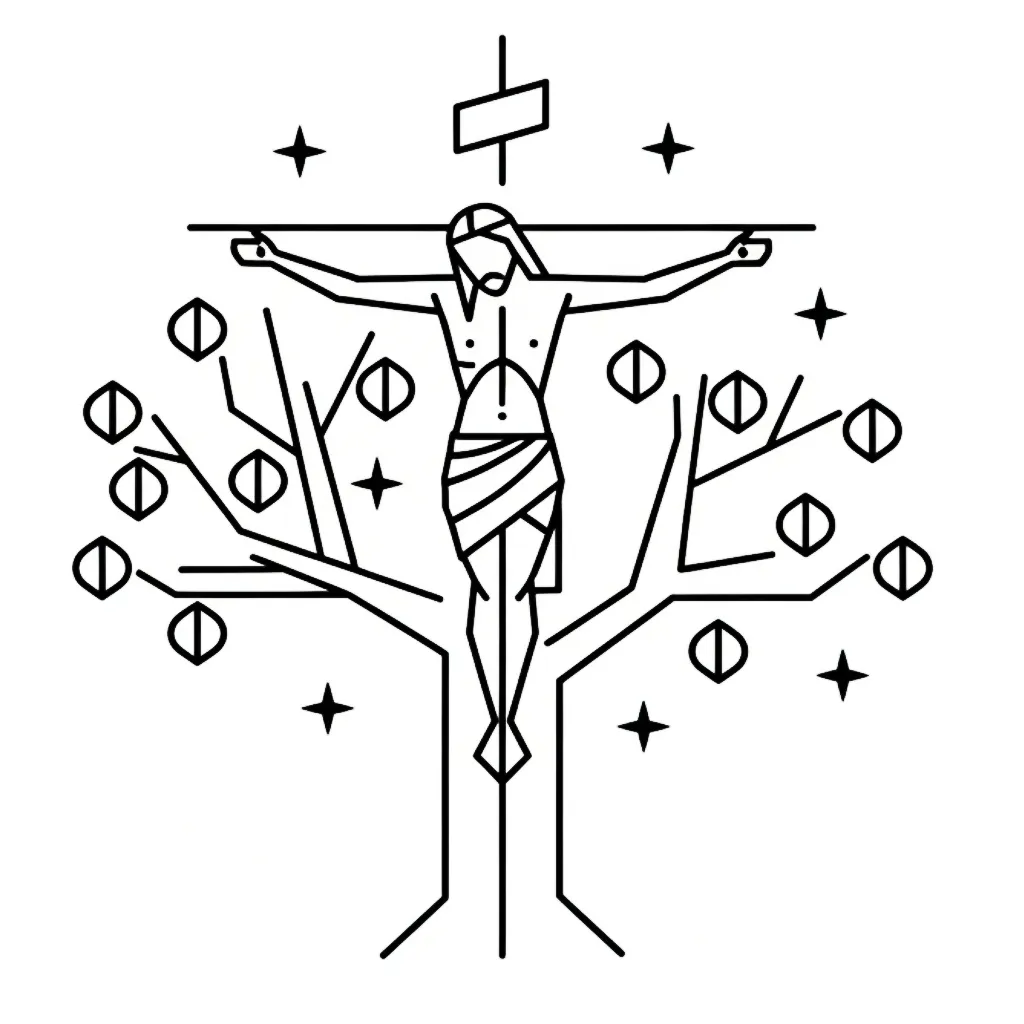
The crucifixion of Jesus is one of the most recognisable events in Scripture, and one of the most precisely encoded. The Gospels describe it as a death on a cross. Acts and the Epistles return repeatedly to the image of a tree. These are not interchangeable words. Each carries specific symbolic weight, and when the full range of threads running through the Bible narrative are applied, the crucifixion emerges as a complete demonstration of how consciousness, identity, and the enforcing structure of reality operate together.
“...It was before your eyes that Jesus Christ was publicly portrayed as crucified.” - Galatians 3:1
The Name Before the Narrative
Thread 8 of the key establishes that names in Scripture are identity codes. A name discloses the nature of the state before the story unfolds. Elohim then enforces the outcome consistent with the meaning embedded in that name.
The name Jesus derives from the Hebrew Yeshua, meaning YHVH saves or salvation. This is not incidental biographical detail. Within the framework of the key, the name declares the nature of the state being occupied before a single event in the Gospel narrative takes place. YHVH/LORD as present consciousness assumes the identity whose very nature is the reversal of the fall. Elohim, as the judges and rulers of that I AM, is bound to enforce what the name already contains. The entire crucifixion and resurrection sequence is Elohim doing precisely that.
Golgotha, the place where the crucifixion occurs, is equally encoded. The Gospels translate it plainly.
He went out with his cross on him to the place which is named Dead Man's Head (in Hebrew, Golgotha).
John 19:17
The place of the skull is not a random geographical location. Within the framework of Thread 8, a place name discloses the nature of the state interacting within consciousness. The skull is the seat of mind. The crucifixion does not happen at a neutral site. It happens within consciousness itself. This is one of the most direct confirmations in the Gospel narrative that the event being described is interior.
Cross and Tree: Two Words, One Mechanism
The Greek word used throughout the Gospels is stauros, an upright stake or cross. The word used in Acts and the Epistles is xylon, meaning tree or wood. The shift is deliberate and the distance between the two words is the distance between the immediate act and its full symbolic depth.
The God of our fathers gave Jesus back to life, whom you had put to death, hanging him on a tree.
Acts 5:30
Christ has made us free from the curse of the law, having become a curse for us: because it is said in the Writings, A curse is on everyone who is hanged on a tree.
Galatians 3:13
He took our sins on himself, giving his body to be nailed to the tree, so that we, dead to sin, might have a new life in righteousness.
1 Peter 2:24
The word xylon pulls the event directly back to the Garden of Eden and its two named trees. The creation narrative is not background. It is the origin of the condition the crucifixion resolves.
Eden: The Original Jurisdictional Error
In the Garden, YHVH/LORD as present consciousness occupied a unified identity, whole, undivided, and in direct relation to the Tree of Life. The Tree of the Knowledge of Good and Evil introduced a different state: the perception of duality, the divided I AM that simultaneously holds worthy and unworthy, near and far, abundance and lack.
And the woman saw that the tree was good for food, and a delight to the eyes, and to be desired to make one wise, and she took of its fruit, and gave it to her husband with her, and he took it.
Genesis 3:6
Thread 7 of the key names this the jurisdictional error. Sin is the mechanical failure of presenting a fragmented or contradictory identity to Elohim. Elohim, operating impartially as the enforcing structure of creation, rules in favour of whatever I AM is dominantly presented. When YHVH/LORD shifted its occupied identity from the Tree of Life to the Tree of Knowledge, Elohim had no option but to enforce the divided state as lived experience. Exile, labour, thorns, and death are Elohim enforcing the filing that was submitted.
The curse of the law that Paul cites in Galatians is not a punitive decree. It is Elohim operating precisely as it always operates. When the I AM is fragmented, the statute enforces fragmentation. Every law in Deuteronomy is Elohim's enforcement mechanism made visible as social and moral code.
The Carpenter and the Structure of Identity
Before the crucifixion is examined as an event, the nature of the one on the tree requires attention. The Gospels describe Jesus as a carpenter.
Is not this the woodworker, the son of Mary, the brother of James and Joses and Judas and Simon?
Mark 6:3
A carpenter works with xylon, with wood and tree. Within the logic of Thread 8, an occupation discloses function just as a name discloses nature. YHVH/LORD as the I AM consciousness is also the builder of internal structures, the agent who takes formless material and fixes it into a coherent, load-bearing form. The carpenter shapes, joins, and constructs. The cross and the tree are both the product of carpentry and the instrument of the carpenter's own fixing.
This is the identity code embedded in the vocation: the one who builds structures from wood is the one whose assumed I AM is fixed upon wood. The craft and the event are the same statement made in two registers.
The Courtroom at the Skull
The crucifixion, taking place at Golgotha, the place of the skull, is the courtroom of consciousness operating at full capacity. Every element of the key's mechanism is present simultaneously.
YHVH/LORD as present consciousness enters the lowest possible state: betrayal, abandonment, physical destruction, and the full weight of the divided human condition. This is not accidental suffering. It is deliberate occupation of the most cursed filing that can be submitted to Elohim.
Ehyeh/I AM as the assumed identity remains declared throughout. Even on the cross, the identity does not collapse into the external conditions.
And he said to them, You are from below; I am from above: you are of this world; I am not of this world.
John 8:23
This declaration precedes the crucifixion and establishes the I AM that is carried into it. YHVH/LORD occupies the cursed state while Ehyeh/I AM remains fixed above it. The two are held in tension, nailed together, which is the precise image of the cross: two planes intersecting, the vertical I AM held against the horizontal pressure of circumstance.
Elohim as the enforcing bench of the courtroom is bound by statute. When YHVH/LORD presents the complete I AM through the totality of death, Elohim has no statute that permits any outcome except the enforcement of that I AM in its fullness. Resurrection is not a miraculous exception to the laws of creation. It is those laws operating exactly as they must.
The Plurality Gathered: Thread 4 and the Passion
Thread 4 describes the Shepherd as YHVH/LORD gathering fragmented internal voices, the scattered impulses and contradictory I AM claims that operate like Legion, into a single unified Ehyeh. The Twelve Disciples represent the twelve internal judges of consciousness, capable of acting independently and incoherently or of being gathered under one governing I AM.
The passion narrative is Thread 4 at its most intense. In Gethsemane the disciples scatter. Peter denies. Judas betrays. The twelve fragment entirely, each reverting to the condition of independent, ungoverned voices. This is Legion reasserting itself, the plural pulling away from the unified Shepherd identity.
Then all the disciples went from him in flight.
Matthew 26:56
The Shepherd does not fragment with them. YHVH/LORD as the governing consciousness holds the I AM through the full collapse of the external plurality. The crucifixion is the moment at which the Shepherd, having been abandoned by every external expression of the twelve, holds the unified identity alone. Elohim enforces it. The regathering of the disciples after the resurrection is Elohim manifesting the unified fold that the Shepherd's assumed I AM contained throughout.
I am the good shepherd, and I have knowledge of my flock, and my flock knows me.
John 10:14
The Vine, the Cup, and the Assumed Identity Before the Cross
Thread 1 of the key traces botanical imagery as the continuous expression of YHVH/LORD assuming an identity before Elohim enforces it. Seed, vine, branch, harvest: the sequence always runs in the same direction. The assumed state precedes the manifested fruit.
The Last Supper is the clearest single demonstration of this in the Gospels. Before the cross, before the arrest, before any external event confirms the outcome, YHVH/LORD presents the cup.
And he took a cup, and gave thanks, and gave it to them, saying, This is my blood of the testament which is given for many.
Mark 14:23-24
The wine as covenant, as Thread 6 identifies it, is the I AM already assumed before Elohim has enforced it through events. The cup is the filing submitted to the courtroom before the verdict is declared. This is the ask, believe, receive sequence made visible at the table: the desire recognised, the identity assumed internally as already true, and Elohim bound to enforce what has been presented. The cross follows the cup as enforcement follows assumption.
The Curse Fully Occupied: Galatians and the Reversal
Paul's statement in Galatians 3:13 requires the Joseph pattern from Thread 5 to be understood properly. The key establishes that Elohim enforces whatever I AM is presented to it without discrimination and without partial application. The depth of the enforcement matches the depth of the occupation. A half-assumed identity produces a partial result. A fully occupied identity produces a complete one.
Joseph in a shallow difficulty produces a modest reversal. Joseph in the deepest pit, sold, enslaved, imprisoned, and falsely accused, produces the most complete reversal available: ruler of Egypt. Elohim enforces the ascent in precise proportion to the depth of the descent that was occupied without abandoning the assumed I AM.
The curse in Galatians 3:13 is not one category of misfortune among others. It is the most extreme possible expression of the divided, fragmented state, the total condition of separation from the unified I AM that the Tree of Knowledge introduced. Every broken filing ever submitted to Elohim by human consciousness is contained within it.
Christ has made us free from the curse of the law, having become a curse for us: because it is said in the Writings, A curse is on everyone who is hanged on a tree.
Galatians 3:13
When YHVH/LORD descends into that state and occupies it completely, holding the assumed I AM through the totality of it rather than retreating from it, Elohim's enforcement of the reversal is equally total. The resurrection is not a modest partial outcome. It is complete because the occupation was complete. The mechanism explains the scale. The depth of what was entered is precisely what determines the scope of what Elohim is bound to enforce in return.
The Cleaving and the Death of the Old Identity
Thread 3 identifies the cleaving principle as the sustained union between YHVH/LORD and the assumed Ehyeh/I AM. The old familiar state is left. The new identity is assumed as fully as a bridegroom takes a wife. Elohim enforces the one flesh union.
Paul applies this directly to the crucifixion.
So that, my brothers, you also were made dead to the law through the body of Christ; so that you might be joined to another, even to him who came back from the dead, so that we might give fruit to God.
Romans 7:4
Death here is not metaphor in the loose sense. It is the precise mechanical act of leaving the old state. The identity that organised itself around the divided perception of the Tree of Knowledge, the I AM structured by the law of opposites, dies on the tree. What cleaves to the risen identity is the new I AM, the assumed state that was held through the entire descent. Elohim enforces the fruit that follows, exactly as the vine produces after its kind.
The woman as the assumed identity, the bride in the cleaving dynamic, is what rises. The old husband, the old governing I AM structured by the curse, is dead. The new union is enforced by Elohim as the one flesh of the new state.
The Veil Torn: Elohim Removes the Division
Immediately after the crucifixion, the Gospel of Matthew records an event that is inseparable from the mechanics of the key.
And the curtain of the Temple was parted in two from the top to the bottom.
Matthew 27:51
The Temple veil divided the outer courts from the holy of holies, the inner sanctuary where the full presence of YHVH/LORD was held. Within the framework of the key, this division is the architectural expression of the fragmented consciousness produced by the Tree of Knowledge: the outer and the inner separated, the surface awareness cut off from the unified I AM at the centre.
When the I AM is fully fixed on the tree and the old identity dies, Elohim tears the veil. The division between fragmented surface consciousness and the unified governing I AM is removed by the enforcing bench itself. This is Elohim executing the statute that the assumed identity demands: when YHVH/LORD presents the complete I AM through death, the barrier maintaining the divided state cannot hold. Elohim removes it from the top, from the governing level downward, not from the bottom upward. The enforcement originates in the statute, not in human effort.
Resurrection as Mandatory Enforcement
The resurrection is not a reward appended to the crucifixion. It is Elohim fulfilling the statute that has been running since Genesis 1. Seed produces after its kind. The vine brings forth fruit. The assumed I AM is enforced as lived reality. When YHVH/LORD presents the complete, unfragmented I AM through the totality of death at the place of the skull, Elohim has no statute that permits any other outcome.
This Jesus has God sent back to life, of which we are all witnesses.
Acts 2:32
The witnesses are the reconstituted plurality, the twelve gathered again under the one Shepherd identity that held through the fragmentation. Elohim enforcing the resurrection is simultaneously Elohim enforcing the fold, the one flesh, the harvest from the vine, and the palace from the pit. Every thread in the key arrives at the same point because they are all expressions of the same mechanism: YHVH/LORD presents Ehyeh/I AM, and Elohim enforces it.
The Tree Fulfilled
What began in the seed at the foundation of the creation narrative arrives here at its fullest expression. The tree that in Eden marked the origin of the divided state becomes the structure upon which the divided state is finally and completely occupied, held, and exhausted. The carpenter fixes the new identity to the tree of human division. The old I AM, the one organised around the curse of the fragmented perception, is nailed there with it and dies.
Elohim, the judges and rulers of I AM, enforce what the name declared from the beginning: YHVH saves. The place of the skull, the interior theatre of consciousness, is where the filing is submitted and the verdict enforced. The veil tears. The fold gathers. The vine brings forth. The assumed identity rises as the only living I AM remaining, and Elohim, bound by the statutes of creation that have never operated any other way, manifests it as the new and irreversible reality.
