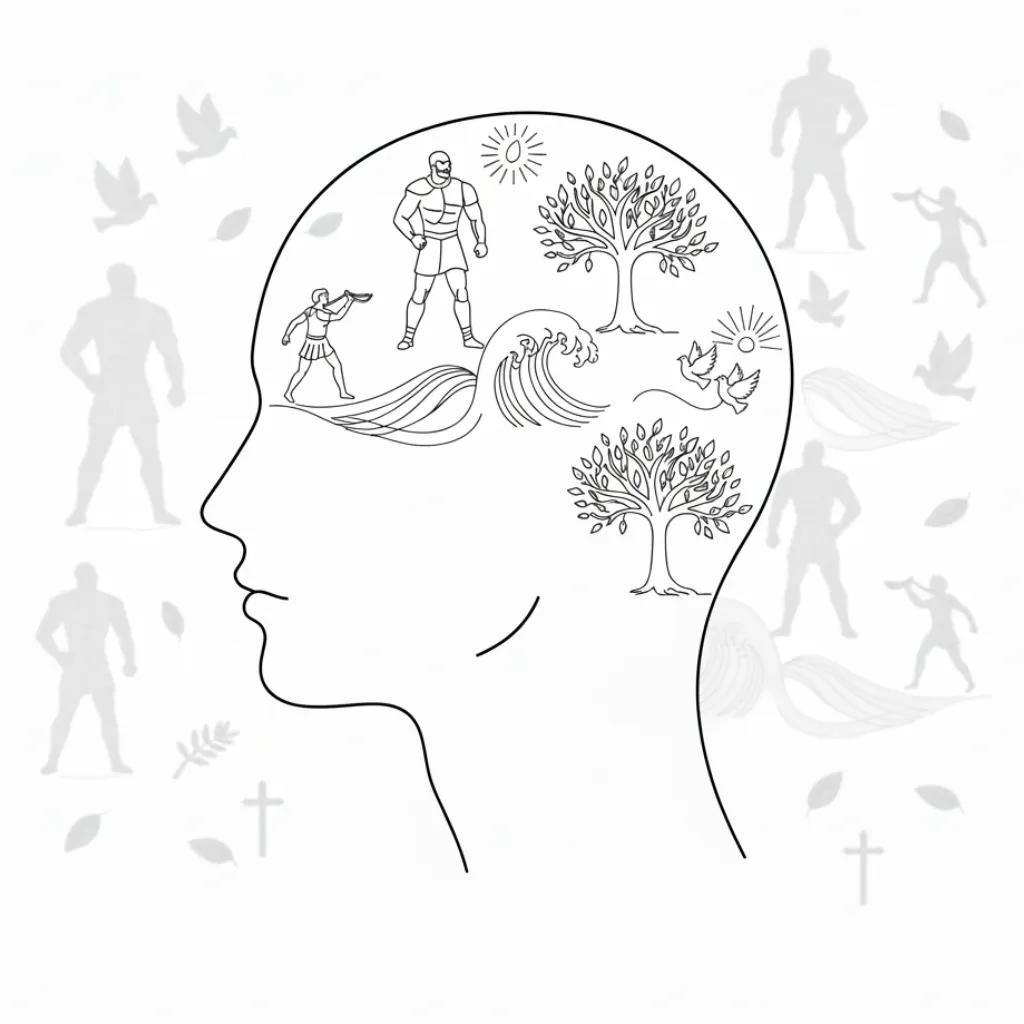
"And God said, Let the earth put forth grass, plants producing seed, and fruit-trees giving fruit, after their sort, with their seed in them, on the earth: and it was so." (Genesis 1:11)
“So is the kingdom of God, as if a man should cast seed into the ground..." — Mark 4:26
Genesis 1:11 is not an observation about nature. It is the statute of creation declared by Elohim — the governing plurality of consciousness — before a single outer form exists. Every seed carries its future within itself, encoded as nature. Every seed reproduces after its kind. This is not a botanical law; it is the operating principle of the inner Elohim: whatever YHVH/LORD assumes as I AM, Elohim enforces after its kind. The assumed identity is the seed. The outer life is its fruit. The harvest cannot differ from what was planted because Elohim enforces the nature of the state, not the desire of the moment.
The verse ends with three words that govern the entire mechanism: and it was so. No delay. No negotiation. Elohim pronounced the statute and the outer world conformed to it immediately. This is the rhythm of enforcement that runs through every narrative in Scripture from Genesis to Revelation.
The Seed in Itself: The Assumed I AM Reproduces After Its Kind
The critical phrase in Genesis 1:11 is "with their seed in them." The fruit does not merely produce seed — it contains the seed of its own reproduction within itself. The assumed identity is self-perpetuating: YHVH/LORD occupying a state as I AM causes Elohim to enforce that state outwardly, and the outer conditions then confirm the inner assumption, which deepens the occupation of that state, which Elohim enforces further. The seed is always in the fruit, and the fruit is always the seed of the next cycle of enforcement.
This is why a state of lack reproduces lack, and a state of abundance reproduces abundance — not as moral reward or punishment, but as mechanical enforcement. Elohim is impartial. It enforces the nature of whatever state YHVH/LORD occupies as I AM. The statute declared in Genesis 1:11 is absolute: after its kind. The inner government does not substitute. It enforces.
2 Corinthians 9:6–7 names this principle directly:
"He who does little sowing will have a little harvest, and he who does much sowing will have a great harvest. Let every man give as he has made up his mind, not in a spirit of grief or by compulsion; for God takes pleasure in a cheerful giver." (2 Corinthians 9:6–7)
The sowing is the assumption. The harvest is what Elohim enforces after its kind. The cheerful giver is YHVH/LORD occupying the I AM of one who already has — giving freely from a state of abundance rather than contracting from a state of lack. Elohim enforces the nature of the state from which the giving comes, not the act of giving itself.
Eden: The Two Trees as the Fruit of Two States
In Eden the seed principle becomes narrative. The garden is the field of consciousness — the mind as cultivated ground — and at its centre stand two trees. Both are grown from seed. Both represent the full-grown fruit of a specific inner state assumed and held until Elohim enforces it into visible form.
The Tree of the Knowledge of Good and Evil is the fruit of a divided assumption — YHVH/LORD occupying a state that perceives itself as subject to external conditions, that judges reality as good or evil based on outer appearances, that reacts to circumstance rather than governing from the assumed I AM. This tree does not produce death as punishment. It produces death as the enforced fruit of its own nature: a consciousness that sees itself at the mercy of what is outside it cannot enforce the life it desires, because the seed it is sowing is one of subjection, not dominion.
The Tree of Life is the fruit of the unified assumption — YHVH/LORD occupying the I AM of the one who already possesses the desired state, holding that identity with complete inner conviction regardless of outer appearances. Its fruit is life because the nature of the state assumed is life. Elohim enforces after its kind. The tree bears fruit every month (Revelation 22:2) because the assumption is sustained without interruption — the seed is perpetually in the fruit, and Elohim perpetually enforces it.
Isaiah names the mechanism of the word that goes out and does not return empty:
"For as the rain and the snow come down from heaven, and go not back there, but give water to the earth, making it fertile and green, giving seed to him who has need of seed and bread to him who has need of food: so my word will be which goes out of my mouth: it will not come back to me without effect, but it will give effect to my purpose, and do that for which I sent it." (Isaiah 55:10–11)
The word that goes out is the assumed I AM presented to Elohim for enforcement. It does not return empty because Elohim is bound by the statutes of creation to enforce it. The rain waters the earth; the assumed identity waters the field of consciousness. The seed springs up. The harvest is certain.
Trees Across Scripture: The Seed Principle Enforced
The tree appears throughout Scripture as the visible confirmation that an inner state has been assumed, held, and enforced into outer form. Every tree in the biblical narrative is a grown seed — an assumed identity that Elohim has brought to its full expression.
Nebuchadnezzar's tree in Daniel 4 is the outward form of his self-image: great, visible to all the earth, sheltering everything beneath it. When his inner state shifts to one of pride that has displaced the governing I AM — claiming dominion as his own rather than as the enforcement of the assumed identity — Elohim cuts the tree down. The fall is not punishment; it is the fruit of the state assumed. The stump remains because the root identity is not destroyed, only pruned. When Nebuchadnezzar's awareness returns to the governing I AM, Elohim enforces restoration: the tree grows again (Daniel 4:36).
The fig tree in Mark 11 bears leaves but no fruit — the outward appearance of a producing state without the inward reality of it. YHVH/LORD occupying an identity that presents itself as fruitful without genuinely assuming the I AM of the one who produces cannot sustain the appearance. Elohim enforces after the nature of the inner state, not the outer display. The tree withers because the seed it contained was not the seed of genuine assumption — it was the appearance of assumption without its substance.
Psalm 1 describes the man whose inner state is rooted in the law of the governing I AM — who meditates day and night, meaning whose attention is sustained on the assumed identity without wavering. Elohim enforces the nature of that sustained state:
"And he will be like a tree planted by the rivers of water, whose fruit comes in its season, whose leaf does not come off; and whatever he does will have a good result." (Psalm 1:3)
The leaf does not wither because the assumption does not waver. The fruit comes in its season because Elohim enforces after its kind in the fullness of its appointed time. The rivers of water are the sustained occupation of the I AM — the consciousness that perpetually waters the assumed identity and Elohim perpetually enforces into fruit.
In Revelation 22:2, the Tree of Life reappears bearing twelve kinds of fruit, one for each month, its leaves for the healing of the nations. The twelve fruits are the twelve faculties of the inner Elohim — all twelve states of the inner government bearing fruit in their appointed season under the one ruling I AM. The healing of the nations is the outer world brought into alignment with the unified assumption. Elohim enforces the wholeness of the assumed identity into every dimension of experienced reality.
The Mustard Seed: The Governing I AM from the Smallest Assumption
"Truly I say to you, if you have faith as a grain of mustard seed, you will say to this mountain, Be moved from this place to that; and it will be moved; and nothing will be impossible to you." (Matthew 17:20)
The mustard seed is the smallest of seeds and becomes the greatest of herbs (Matthew 13:32). The principle is not about the size of the assumption — it is about the nature of it. A genuine assumption, however small its beginning, carries the full nature of the identity within it. Elohim enforces after its kind without diminishment. The mountain — the seemingly immovable outer condition — must move because it is outer and the assumed I AM is inner, and the inner governs the outer by statute.
The seed of faith does not require the mountain to move before it is planted. It requires only that YHVH/LORD genuinely occupy the I AM of the one for whom the mountain has already moved. Elohim then enforces accordingly. The impossibility is not in the mountain — it is in the assumption. Once the assumption is genuine, nothing is impossible, because Elohim is bound to enforce the nature of the state assumed.
Every Story Grows from Genesis 1:11
The statute declared in Genesis 1:11 underlies every transformation narrative in Scripture. Each one demonstrates the same sequence: an identity assumed, held through adverse circumstance, and enforced by Elohim into its full outer expression.
Abraham receives the promise: "So shall your seed be." (Genesis 15:5). The seed is the assumed identity — father of many — and Elohim must enforce it after its kind. The years between the promise and the birth of Isaac are not delay; they are the period between sowing and harvest, during which the assumed identity is held and Elohim works the enforcement.
Joseph's dream is the seed. The pit, Potiphar's house, and the prison are the ground through which the seed passes before Elohim enforces the harvest. Joseph does not abandon the assumed identity — the I AM of the ruler — at any stage of the process. Elohim enforces increase at every stage (Genesis 39:3) because the nature of the state held is increase, and Elohim enforces after its kind. Pit to palace is not reversal — it is the full-grown fruit of the seed assumed in the dream.
The kingdom parables of Jesus are direct expositions of Genesis 1:11. "The kingdom of God is as if a man puts seed in the earth." (Mark 4:26). The kingdom — the full outer expression of the governing I AM — grows from a seed planted in the ground of consciousness. The man sleeps and rises, and the seed springs up without his knowing how. Elohim enforces the nature of the state after its kind without requiring the conscious mind to understand the mechanism. The harvest is certain because the statute is absolute.
The crucifixion and resurrection complete the arc. The assumed identity is fixed — planted so deeply in the field of consciousness that it cannot be dislodged by any outer condition. The cross is the planting; the resurrection is the fruit. The old identity — the one that must die for the new one to rise — is the seed that falls into the ground:
"Truly I say to you, If a grain of wheat does not go into the earth, it is still a grain of wheat and nothing more; but if it goes into the earth and comes to an end, then it gives much fruit." (John 12:24)
The death of the old assumed identity is not loss. It is the seed entering the ground so that Elohim can enforce its full harvest. The resurrection is the governed fruit of the planted assumption — the new I AM rising in the outer world as the full expression of what was inwardly assumed and held.
Made In His Image: To Assume Is to Sow
"And God made man in his image, in the image of God he made him: male and female he made them." (Genesis 1:27)
To be made in the image of Elohim is to carry the same creative mechanism within consciousness. Elohim creates by declaring the identity to be formed and enforcing it. Man — the assumed identity, the I AM — creates by the same mechanism: YHVH/LORD assumes the I AM, and the inner Elohim enforces it into outer likeness. Every assumption is a sowing. Every inner state held is a seed placed in the ground of consciousness. Elohim enforces after its kind without exception.
The outer world is not imposed on YHVH/LORD from without. It is grown from within, enforced by the inner Elohim in exact conformity with the nature of the assumed I AM. As Proverbs 27:19 states:
"As in water face answers to face, so the heart of man to man." (Proverbs 27:19)
The outer world reflects the inner state with the same precision that water reflects a face. YHVH/LORD sees in the outer world the exact nature of the I AM it has been occupying, enforced by Elohim after its kind. The reflection does not precede the face. The assumed identity does not follow the outer condition. The seed is always first. Elohim enforces the harvest always after.
Conclusion: And It Was So
Genesis 1:11 declares the governing statute of all creation: every seed bears fruit after its kind, with its seed in itself. This is the mechanism Elohim operates by throughout all of Scripture. YHVH/LORD assumes an identity as I AM — the seed is planted. Elohim enforces the nature of that state into outer form — the fruit grows. The fruit contains the seed of the next cycle of enforcement — the assumed identity is perpetuated until a new one is consciously assumed in its place.
From the two trees of Eden to the Tree of Life in Revelation, from Abraham's promise to Joseph's palace, from the mustard seed to the resurrection — every narrative in Scripture is Genesis 1:11 in operation. The inner state is always sowing. Elohim is always enforcing. The harvest is always after its kind.
And it was so.
