The Name of God is:
'Judges' and 'Rulers'
of
I AM that I AM
The Bible is written as a kingdom. Every kingdom has a Lord, judges, rulers, laws, and authority. Scripture repeatedly calls God Judge, Ruler, and King, not to describe domination, but governance. In biblical psychology, authority means the right to judge, and judgement means the power to define what something is. The Kingdom of God is within you, and its authority operates upon one thing alone: I AM.
Genesis 1:26 — Man in God's Image
And God said, Let us make man in our image, after our likeness: and let them have rule over the fish of the sea and over the birds of the air and over the cattle and over all the earth and over every living thing which goes flat on the earth. — Genesis 1:26
The word translated "God" in this verse is Elohim, (Strong's Number H430), a plural name that the key identifies as the Judges and Rulers of I AM. These are not external beings but the structured plurality of consciousness itself, the many internal governing voices that judge, stabilise, and execute whatever identity is dominantly assumed. When Elohim says "let us make man in our image," the creative act described is not the fashioning of flesh but the establishment of identity as the primary legal and creative unit.
Man made in the image of God means that the reader, as YHVH/LORD, is endowed with the same authority of self-definition that Elohim exercises. The "man" that comes into being is not a body but a judgement: the verdict Elohim is bound to enforce once YHVH/LORD assumes a particular Ehyeh/I AM. In short, the states you accept as true of I AM are the very man you experience yourself to be. Consciousness does not obey circumstance. Circumstance obeys the judgements placed upon I AM.
Exodus 3:14 — The Name of God Is I AM
And God said to Moses, I AM THAT I AM: and he said, Say to the children of Israel, I AM has sent me to you. — Exodus 3:14
When Moses asks for God's name, he is not given a title. He is given a declaration of governmental structure. The full operational Name revealed here is Elohim of Ehyeh/I AM, which the key renders as the Judges and Rulers of I AM. I AM is the seat of judgement. It is not located outside the reader. It is the precise point within awareness from which all meaning is assigned and all identity is governed.
In Hebrew, Ehyeh-Asher-Ehyeh means I will be what I will be. The verb at its root, hayah, carries the sense of existing and becoming. This is not a prophecy about a distant deity. It is a disclosure of jurisdiction: what YHVH/LORD judges itself to be, Elohim must enforce as lived experience. The repetition of I AM THAT I AM is not redundancy. It announces the Law of Identical Harvest. Identity returns itself. The judgement placed upon I AM is the law under which experience unfolds. This mechanism is examined further at YHVH and Ehyeh: The Linguistic Engine of Transformation.
The three terms of the key operate here in full. YHVH/LORD is present consciousness, the Existing One, standing before the burning bush as awareness encountering its current circumstance. Ehyeh/I AM is the assumed identity, the TO BE that YHVH/LORD is invited to occupy as a living verdict. Elohim, the Judges and Rulers, are the internal government bound by the statutes of creation to enforce whatever identity is presented to them. The Name God gives Moses is therefore not a label but an instruction in the mechanics of reality: assume the I AM and the judges of consciousness must uphold it.
The Law of Assumption: Identity Precedes Experience
The Law of Assumption is the lawful operation of judgement within consciousness. To assume is to rule. To persist in an assumption is to legislate. The key describes this as the Ask, Believe, Receive sequence: YHVH/LORD recognises the desire and presents it as a claim; Ehyeh/I AM is assumed internally as already true; Elohim enforces the outcome as manifest reality.
You must assume the feeling of the wish fulfilled, not as an effort of willpower but as a settling into identity. Experience does not change first. The authority of I AM changes first. When you say "I AM healthy," you are not reciting an affirmation. You are entering a verdict. You are presenting an Ehyeh to Elohim, and Elohim is bound by the statutes of creation to enforce it. The kingdom responds not to what you wish were true but to what YHVH/LORD presents as I AM.
Solomon's Temple: A Symbol of Inner Structure
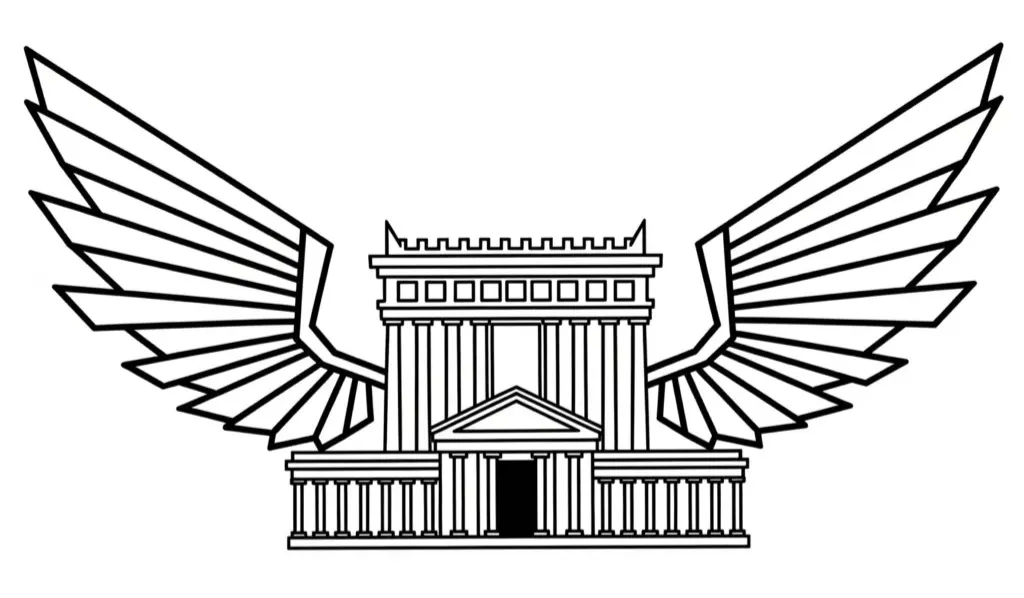
Solomon's Temple maps the ordered structure of this inner government. The Holy of Holies is the seat of I AM itself, the innermost chamber where the verdict of identity is held. The outer courts are the states entered by assumption, the conditions that have been accepted as true by YHVH/LORD. To build the temple is to establish disciplined authority over thought and feeling so that the identity held in the inner chamber is not contaminated by the noise of the outer courts. The architecture is not decorative. It is a diagram of consciousness governance.
The Triune Nature of Man: Spirit, Soul, and Body
The triune structure of man mirrors the three terms of the key. Spirit, identified with I AM and the Ask, is the presiding awareness, YHVH/LORD as Lord. Soul, identified with Imagination and Believe, is the judicial chamber where YHVH/LORD presents Ehyeh/I AM to Elohim. Body, identified with Manifestation and Receive, is the visible decree of the inner judgement, the record of what Elohim has enforced. I AM unifies the process. What is judged internally becomes law externally. The triune structure is not theology. It is the operational description of how identity passes from assumption to experience.
Jesus' I AM Sayings: Consciousness in Action
Jesus in the narrative represents YHVH/LORD fully awakened to its authority as the assuming consciousness. His I AM statements are not claims about a biological individual. They are rulings issued from within the inner kingdom. Each one is an Ehyeh presented to Elohim without hesitation or contradiction.
I am the light of the world: he who comes after me will not go in the dark, but will have the light of life. — John 8:12
I am the bread of life: he who comes to me will never be in need of food, and he who has faith in me will never be in need of drink. — John 6:35
I am the way, the true and living way: no one comes to the Father but by me. — John 14:6
I am the resurrection and the life: he who has faith in me will have life even if he is dead. — John 11:25
Truly I say to you, Before Abraham came into being, I am. — John 8:58
Each declaration follows the same governmental pattern: YHVH/LORD presents an Ehyeh/I AM and Elohim must enforce it. Jesus speaks not as a man reacting to conditions but as consciousness issuing its own statutes. "Before Abraham was, I AM" is particularly precise: it places I AM prior to all named states, prior to all assumed histories. The Existing One does not derive its identity from circumstance. It governs circumstance by declaring what it is.
The Trinity as the Flow of Authority
Read through the key, the Trinity maps directly onto the linguistic engine. The Father is I AM itself, authority in its pure form, Ehyeh as the ground of all being. The Son is the assumed identity, authority exercised, YHVH/LORD occupying a specific Ehyeh/I AM and presenting it to the inner government. The Spirit is manifestation, authority expressed, the enforced outcome that Elohim produces once the verdict is held. The Father sends the Son in the same way that I AM generates the assumed identity from which experience flows. The Spirit proceeds from both because manifestation is always the joint product of the Existing One and the identity it occupies.
Names as Identity Codes in the Narrative
The key establishes that in Scripture, names are not labels. They are compressed identity codes that reveal the nature of the state being occupied. YHVH/LORD encounters or assumes a named character. Ehyeh/I AM becomes the meaning embedded in that name. Elohim enforces the outcome consistent with the nature the name encodes.
This pattern is visible throughout the narrative that surrounds Exodus 3:14. Moses himself, whose name carries the sense of drawn out, is YHVH/LORD in a state of reversal: present consciousness standing in obscurity, about to assume an identity from which Elohim will draw forth an entire nation. Israel, meaning he shall prevail, is the name given when struggle resolves into governing identity. Abraham, meaning father of many, contains the nature of multiplication within the state itself. The story does not create the outcome. The name already declares it. The story is Elohim enforcing what the assumed I AM has already established.
Resurrection: The Reclamation of Authority
Resurrection in this framework is the moment YHVH/LORD stops deriving its Ehyeh/I AM from external conditions and resumes its role as the one who presents the verdict to Elohim. Identity is no longer judged by circumstance. Circumstance is judged by identity. This is the awakening the narrative points toward throughout: not escape from the world but the recovery of governmental authority within consciousness.
I am he who was dead, and now I am living for ever and ever, and I have the keys of death and of Hell. — Revelation 1:18
The keys of death and of the unseen realm are the authority to define what I AM is and is not. To hold those keys is to no longer be governed by the states into which unconscious assumption has descended. It is to govern them.
The Practice: Living From I AM
You are always ruling. The only question is whether the ruling is conscious or unconscious. When YHVH/LORD presents an Ehyeh/I AM that reads "I am lacking," or "I am unseen," or "I am afraid," Elohim enforces it without partiality. The statutes of creation do not distinguish between deliberate and accidental verdicts. This is what the key identifies as sin: not moral failure but jurisdictional error, a false filing in the courtroom of consciousness. Repentance in this sense is not remorse. It is the amendment of the filing, the deliberate shift of I AM back toward the blueprint.
To live from I AM is to accept the office of judge within the inner kingdom and to issue verdicts with the seriousness that office carries. "I AM chosen," "I AM peaceful," "I AM already it," "I AM the one I want to be" are not affirmations meant to persuade an external audience. They are judgements presented to Elohim. They are verdicts that the inner government is constitutionally required to enforce.
Conclusion: I AM as the Divine Formula
Exodus 3:14 does not record the name of a distant deity. It discloses the operational structure of consciousness itself. The full Name is Elohim of Ehyeh/I AM: the Judges and Rulers of I AM. YHVH/LORD is the Existing One, present awareness, the consciousness that stands at the bush and receives the commission. Ehyeh/I AM is the assumed identity, the TO BE that YHVH/LORD is authorised to occupy. Elohim is the internal government that enforces the occupied identity as the structure of experienced reality.
The Bible read this way is a kingdom manual. Authority governs identity. Identity governs experience. The declaration I AM THAT I AM is the revelation that the judge, the judgement, and the enforcement are not three separate things. They are one governmental act, continuous and self-returning. What you judge yourself to be, you must become. When you understand I AM, you understand God.
About The Author | Exodus 3:14: I AM | Law Of Identical Harvest
