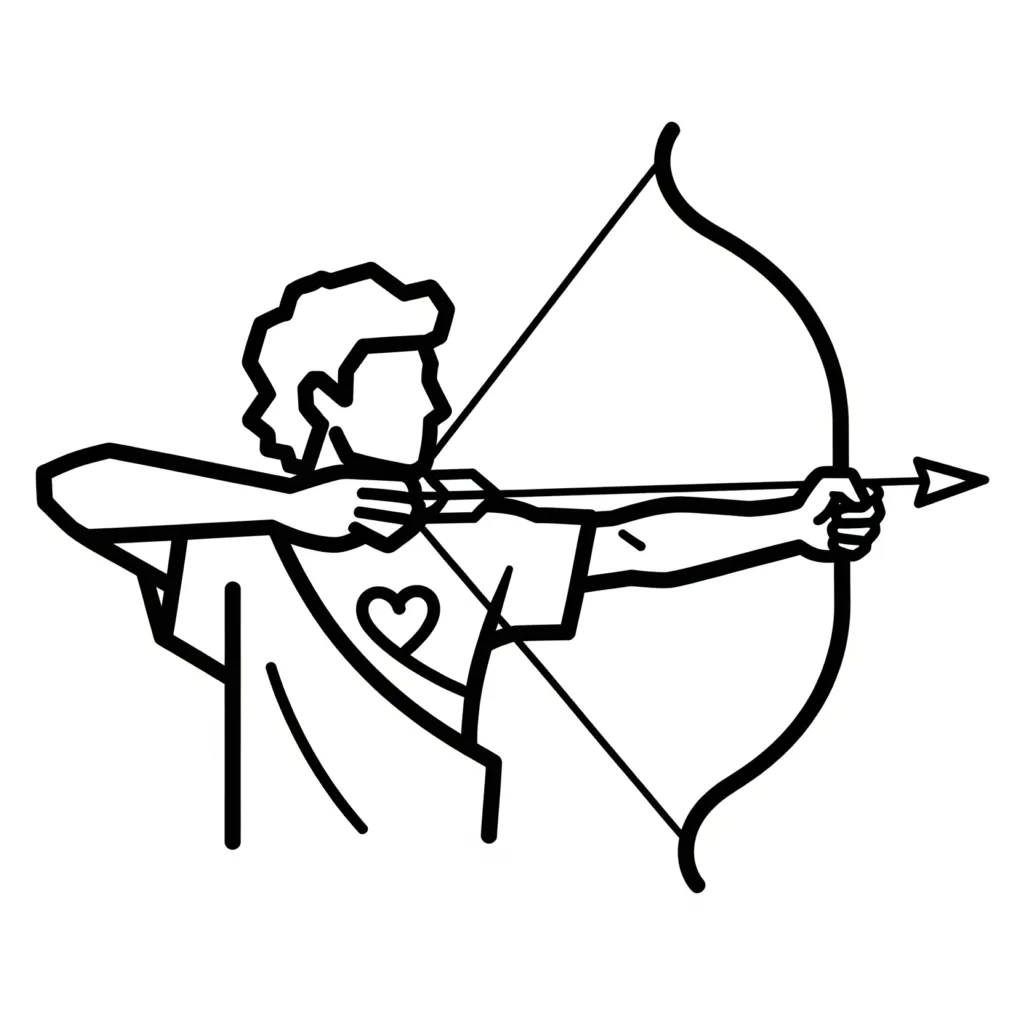
The Bible uses archery language to define two of its most precise concepts: praise and sin. This is not coincidental. Scripture is deliberately symbolic, its stories functioning as psychological instruction rather than historical record. The entire drama plays out within the consciousness of the reader, revealing how what is held inwardly as identity becomes outwardly as experience.
Praise in Hebrew is yadah, meaning to shoot, to throw, or to cast as an archer releases an arrow. Aim is an anagram of I AM. The archer who praises is the one who fixes their gaze on the mark and releases with full commitment to hitting it.
Sin in Hebrew is chata, and in Greek hamartia: both carry the same root meaning, to miss the mark. The archer draws, but the arrow falls wide. This is the precision Scripture maintains throughout: praise is conscious assumption aimed true; sin is assumption scattered or misdirected.
Judah: The State of Praise
Judah, one of the twelve sons of Jacob, is the first figure in Scripture named Praise. His very name is the act of shooting the arrow, deliberate, targeted, and fully committed. Within the framework of the linguistic key, names in Scripture function as identity codes: they do not label a person so much as disclose the nature of the state being occupied. The story that unfolds around that name is simply Elohim enforcing what the name already declares.
Judah is the part of consciousness that lifts awareness toward the fulfilment of the desire rather than remaining fixed on the problem. He does not deliberate. He does not calculate the route. He assumes with certainty and moves. Through Judah, the biblical narrative shows that praise is the initiating act of creation.
Leah names him at his birth:
And she became with child again, and had a son; and she said, Now will I give praise to the Lord; so she gave him the name Judah; then she gave birth to no more children. Genesis 29:35
The state is established at the moment of its naming. Elohim, the judges and rulers of that I AM, begin enforcing from that point forward.
Praise: The Archer's Inward Stance
When consciousness assumes the feeling of the wish fulfilled, it occupies the position of Judah. It praises before there is external evidence. The inner vision is lifted and aimed at what has already been chosen as true, not at the difficulty or the gap.
Praise is not emotional performance or religious noise. It is the precise, inward act of fixing YHVH, present awareness, upon the end and feeling its reality as current fact. An archer does not watch the bow. The archer looks at the mark. The mechanics of ask, believe, receive follow that same sequence: YHVH recognises the desire, Ehyeh assumes the identity of fulfilment as already true, and Elohim enforces the outcome.
Praise in this sense is not what follows evidence. It is what precedes it. It always comes before manifestation, not after.
From Praise to the Realised State: Judah, David, and the Christ Figure
The lineage running from Judah through David to the Christ figure is not biography. It is a sequence of identity states, each name encoding a progressive quality that Elohim is bound to enforce.
Judah means Praise. David means Beloved. The Christ figure represents the fully realised identity, the state in which YHVH and Ehyeh are in complete union and Elohim enforces without resistance. The sequence reads as instruction: praise initiates, the beloved state follows as its fruit, and full realisation is the destination the sequence has always been moving toward.
When the state of Beloved. Be Loved is occupied, the world that Elohim governs responds accordingly. This is not reward for virtue. It is Elohim enforcing the nature of the assumed I AM after its kind. The beloved is treated as beloved because that is the quality of the state being presented to the internal judges and rulers.
Jonathan, David, and the Boy: The Mechanics of the Arrow
The scene in 1 Samuel 20 is one of the most precisely constructed demonstrations of how praise operates as a mechanism. Read through the surface narrative, every figure and every action corresponds exactly to the courtroom of consciousness described in the key.
Jonathan functions as YHVH, present consciousness, the one holding the bow, the one who shoots. He is awareness in its active, choosing posture. David is the Beloved state, the assumed identity, hidden and waiting in the field. The boy is Elohim's instrument in the world, the means by which the verdict is carried into lived experience. He does not understand what he is doing. He simply runs and retrieves. This is precisely how Elohim enforces: the means are not visible to ordinary perception, only the result arrives.
The entire scene turns on a single question: where does the arrow land relative to the boy? Jonathan has pre-arranged the signal. If the arrow falls on the near side, David is safe. If it goes beyond the boy, David must flee. The words spoken over the arrow after it is released determine what the boy is sent to retrieve and report back.
And I will send my boy to have a look for the arrow. And if I say to him, See, the arrow is on this side of you; take it up! then you may come; for there is peace for you and no evil, by the living Lord. But if I say to the boy, See, the arrow has gone past you: then go on your way, for the Lord has sent you away. 1 Samuel 20:21-22
When the moment comes, Jonathan shoots beyond the boy and calls out that the arrow has gone past him. The signal is clear. David must go. The boy retrieves the arrow and brings it back, having carried the message entirely without understanding it:
But the boy had no idea what was going on; only Jonathan and David had knowledge of it. 1 Samuel 20:39
This detail is not incidental. It is the key's description of Elohim made visible in narrative. The internal judges and rulers enforce the statute of the assumed identity without needing to comprehend it. The circumstances, the people, the timing, the events that appear to arise naturally in the world are the boy running in the field. They carry the outcome of what has been aimed and released. They do not know what they are doing. They simply deliver.
Jonathan then hands the bow and arrows to the boy and sends him back to the city. His role as the active shooter is complete. The assumption has been released. What follows belongs to Elohim.
And Jonathan gave his bow and arrows to the boy, and said to him, Take these and go back to the town. 1 Samuel 20:40
Once the arrow of praise has been loosed, the instrument of its release is set aside. Consciousness does not cling to the bow after the arrow has flown. The act of assumption is complete when it is complete. Elohim carries it forward.
Sin: When Consciousness Misses the Mark
To sin is to miss. YHVH, present consciousness, presents an identity of lack, fear, or contradiction to Elohim, and Elohim, impartially, enforces that filing. The mark is not hit because the arrow was never aimed at it. Consciousness was fixed on the absence rather than the presence of the desired state.
Sin is a jurisdictional error, not a moral category. The Law of Assumption does not reward or punish. It simply manifests what has been impressed upon it. If YHVH presents lack, Elohim rules in favour of lack. If YHVH presents the palace, Elohim enforces the palace. The court is impartial. The filing determines the verdict.
Repentance within this framework is not guilt but correction. It is amending the filing, returning the arrow to the proper aim, re-occupying the chosen I AM, and allowing Elohim to re-establish alignment. Genesis 4 shows this directly:
If you do well, will you not be lifted up? And if you do not do well, sin is waiting at the door, desiring to have you, but you must be its master. Genesis 4:7
Sin crouches at the door not as an external force but as the enforced consequence of misdirected assumption. The instruction is not to suppress desire but to master the direction of the aim.
The Tribal Order: Judah Marches First
In the wilderness account, when Israel breaks camp and moves, the tribe of Judah leads. This is not administrative detail. It is symbolic instruction embedded in narrative structure.
And the children of Judah went first with their armies. Numbers 10:14
Praise must come before the evidence, before the result, before the visible movement of circumstances. The rest of the camp follows because the rest of experience follows when praise has gone ahead. Elohim enforces after the I AM has been assumed. The tribe of Judah leading the march is the biblical picture of assumption preceding manifestation.
The cleaving principle operates within this same order. YHVH leaves the familiar state, the habitual identity, the old filing, and cleaves to the new one. Judah is the state that enables that leaving, because praise is the act of turning fully toward the chosen identity and away from the former one. The old state is not fought. It is simply no longer occupied.
Praise and Sin as the Two Postures of Consciousness
Judah lives within the reader. So does the capacity to miss the mark. In every moment, awareness is either assuming the end with precision, praising, or it is fixed on the absence of what is desired, sinning. These are not moral positions. They are mechanical ones. The result is not divine reward or punishment but manifestation in kind, Elohim enforcing whatever has been presented.
The Bible traces this from Judah through David to the Christ figure, showing the full arc: from the initiating act of praise, through the beloved state as its fruit, to the fully realised identity that was always the destination. The scene in 1 Samuel 20 sits at the heart of that arc, showing not just that praise works but precisely how it works. Jonathan shoots. The boy runs without understanding. David, the Beloved state, is guided forward by what he could not have arranged himself.
The archery image is exact. Draw the bow of awareness. Fix the eye of consciousness on the mark. Assume with the settled certainty of Judah, who did not ask how. Release. And watch Elohim, the judges and rulers of that I AM, send the boy into the field to carry the outcome home.
About The Author | Hitting Or Missing the Mark (AIM) Series | Praise Series | Genesis 4:7 Series
