“And let us not be weary in well doing: for in due season we shall reap, if we faint not.”
— Galatians 6:9
Faith is a state of being. It is the invisible certainty that defines and directs every visible outcome. In the biblical story of manifestation, Abraham stands as the first man to fully embody this principle. His life maps the birth of faith as active assumption: Ehyeh/I AM occupied before the evidence arrives, held without wavering until Elohim enforces the outcome.
The First Stirring of Faith
Abraham's journey begins in Genesis 12, where YHVH/LORD presents the promise without evidence, plan, or support:
Now the Lord said to Abram, Go out of your country, and away from your family and your father's house, into a land which I will show you: And I will make of you a great nation, blessing you and making your name great; and you will be a blessing.
Genesis 12:1-2
Nothing in the visible world supports this. Present consciousness surveys barrenness on every side. But the call is not addressed to appearances; it is addressed to identity. YHVH/LORD is being directed to leave the familiar state, detach from the father's house of habitual assumption, and cleave to a new Ehyeh/I AM. The leave-and-cleave structure is already operating here at the very opening of Abraham's story. The land that will be shown is not a destination on a map; it is the expanded state of consciousness that Elohim is bound to enforce once the new identity is assumed and sustained.
The Power of the Name: Identity Transformation
In Genesis 17, the mechanism becomes explicit. YHVH/LORD changes Abram's name to Abraham:
No longer will your name be Abram, but Abraham will be your name; for I have made you a father of nations of peoples.
Genesis 17:5
Abram means "exalted father." Abraham means "father of a multitude." Within the framework of names as identity codes, a name discloses the intrinsic nature of the state being occupied. Elohim enforces identity after its kind, and the name carries the seed of the outcome before the narrative unfolds. The renaming is therefore a formal reassignment of Ehyeh/I AM. YHVH/LORD no longer presents "exalted father" to the inner court; the filing has been amended to "father of a multitude," and Elohim, the Judges and Rulers of that I AM, must now uphold it.
Sarah's name is changed in the same passage, from Sarai to Sarah, meaning princess. Her barrenness had been the outward confirmation of the old state. The moment both names shift, the old identity has no legal standing in the courtroom of consciousness. Paul reads this correctly in Romans:
As it is written, I have made you a father of nations of peoples, before him in whom he had faith, even God, who gives life to the dead, and says that the thing which does not exist is as if it does.
Romans 4:17
Elohim calls things that are not as though they are because the assumed I AM is already the governing statute. The physical evidence follows; it does not lead.
God's Assurance: The Shield and Reward
Genesis 15 opens with YHVH/LORD receiving an inner assurance:
After these things, the word of the Lord came to Abram in a vision, saying, Have no fear, Abram: I will keep you safe, and great will be your reward.
Genesis 15:1
The shield is present consciousness protecting the assumed identity from doubt. The reward is Elohim enforcing the fulfilment of what has been assumed. Imagination both defends and actualises the Promise.
Abram's Doubt: Childlessness
Abram immediately surfaces the gap between his present state and the promised one:
And Abram said, O Lord God, what will you give me, seeing that I am going on without a child, and the heir of my house is Eliezer of Damascus?
Genesis 15:2
This is YHVH/LORD's resistance to the unseen. Doubt arises naturally when a new I AM is assumed against the weight of present circumstances. Rather than dismissing the doubt, the narrative uses it to frame the space in which Elohim will execute the Promise.
The Stars and the Promise
YHVH/LORD is then directed outward and upward:
And he took him outside, and said, Let your eyes be turned to heaven, and see if the number of the stars is measurable: and he said to him, So will your seed be.
Genesis 15:5
The stars are infinite potentials of assumed identity. YHVH/LORD gazes beyond present limits, extending vision past the boundaries of current circumstance, while Elohim prepares to manifest that multiplicity. The seed declared here is the planted assumption; its number is without limit because the assumed I AM places no ceiling on what Elohim must enforce.
Faith Counted as Righteousness
And he had faith in the Lord, and it was put to his account as righteousness.
Genesis 15:6
Faith here is the full occupation of Ehyeh/I AM. Holding the feeling of the wish fulfilled aligns YHVH/LORD with the assumed identity, and Elohim enforces it. Righteousness, in the judicial mechanics of the key, means alignment: the filing matches the statute, so the court rules in favour of the assumed state. This is the opposite of sin, which is the jurisdictional error of presenting a contradictory or fragmented I AM.
A Deeper Assurance: Abram's Question
And he said, O Lord God, by what sign am I to be certain that I will have it for my heritage?
Genesis 15:8
Seeking confirmation reflects the shift from belief to inner knowing. YHVH/LORD questions; Ehyeh/I AM maintains certainty; Elohim continues enforcement of the assumed state. The question is not a failure of faith but a deepening of it, the moment where YHVH/LORD asks Elohim to confirm the ruling through a tangible act.
The Covenant Ritual: Dividing the Animals
God instructs Abram to bring a heifer, a she-goat, and a ram, each three years old, along with a turtledove and a young pigeon. Abram cuts the larger animals in two and lays the halves opposite each other, but leaves the birds whole. He then drives away the birds of prey that descend on the carcasses.
And he got a heifer of three years old, and a she-goat of three years old, and a ram of three years old, and a turtledove and a young pigeon. And he took all these and put them in two parts, face to face: but the birds he did not cut in two.
Genesis 15:9-10
The divided animals represent old states of consciousness laid open and surrendered to make way for the new I AM. Exposing their innards is a conscious act of acknowledgment, a release of the familiar patterns that had sustained the old identity. The birds of prey that attempt to settle on the pieces are the intrusive doubts and contrary voices that would reclaim the vacated state; Abram drives them off, maintaining the integrity of the sacrifice.
The Dark Sleep and Prophetic Vision
And when the sun was going down, a deep sleep came on Abram; and a dark cloud of fear came over him. And God said to Abram, Have no doubt that your seed will be living in a land which is not theirs, as servants to a people who will be cruel to them, for four hundred years; But I will be the judge of that nation whose servants they are, and after that they will come out with great wealth. But you will go to your fathers in peace; you will be put to rest at a good old age. And in the fourth generation they will come back here: for the punishment of the Amorites is not complete till then.
Genesis 15:12-16
The deep sleep is YHVH/LORD surrendering the assumed I AM to the inner mechanism. Darkness and fear are the natural resistance that precedes transformation, the void between the old state vacated and the new state not yet visible in the world. The seed planted in consciousness will pass through a prolonged period of apparent bondage before Elohim manifests the new reality. The 400 years encode the full cycle of inner resistance before release. "Great wealth" is the tangible outcome of inner persistence; it is what Elohim enforces when the assumed state finally surfaces in the world.
The Smoking Firepot and Blazing Torch
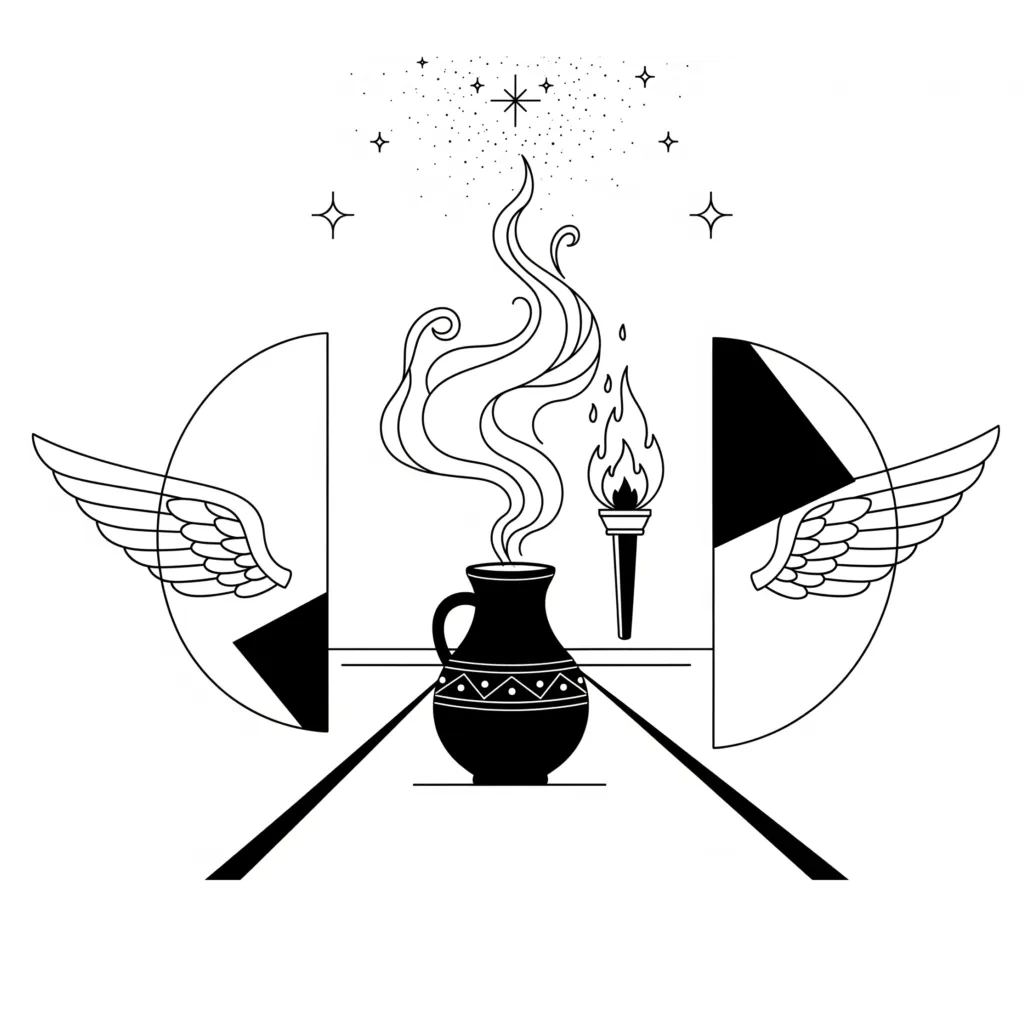
And it came about that when the sun had gone down and it was dark, a smoking fire-pot and a flaming torch went between the two parts of the animals.
Genesis 15:17
The smoking firepot is the unseen, transformative action of Elohim working on the assumed identity beneath the threshold of conscious awareness. The blazing torch is YHVH/LORD's conscious awareness of the I AM, the living flame of present consciousness. Their passing between the divided pieces seals the triad: present consciousness and assumed identity move together through the surrendered old state, and the union produces the ruling. Elohim has received the filing.
The Seal of the Covenant: The Promised Land
On that day the Lord made an agreement with Abram, saying, To your seed I give this land, from the river of Egypt to the great river, the river Euphrates.
Genesis 15:18
The land is expanded consciousness. Defining its borders illustrates the scope of imagination now under Elohim's enforcement. YHVH/LORD has presented the I AM; Elohim enforces it across the full territory of the assumed state.
Isaac: The Laughter of Fulfilment
The child of promise is named Isaac, meaning "he laughs." The name itself carries the nature of the state. When Sarah hears in Genesis 18 that she will bear a son, she laughs within herself, and YHVH/LORD's response is not rebuke but confirmation: "Is anything too hard for the Lord?" (Genesis 18:14). The laughter is not disbelief; it is the first involuntary movement of the assumed I AM breaking through into felt experience, the recognition that arises when the inner state has been occupied long enough that the emotions begin to confirm it.
Isaac is born, and Sarah declares:
And Sarah said, God has made laughter for me; everyone who hears will be laughing with me. And she said, Who would have said to Abraham that Sarah would give a child the breast? For I have given him a son in his old age.
Genesis 21:6-7
Isaac is the first living fruit of the union between YHVH/LORD, Abraham as present consciousness assuming the promise, and Ehyeh/I AM, Sarah as the imaginative capacity that had seemed barren. The leave-and-cleave principle is fully realised: Abraham left the familiar state of childlessness, cleaved to the identity of father of a multitude, and Elohim enforced the one-flesh outcome as a child in the visible world. Paul's reading of Abraham's faith in Romans names the governing mechanics plainly:
And not being feeble in faith, he did not give thought to his body, now as good as dead (he being about a hundred years old), or to the deadness of Sarah's body: He did not give way to doubt about the undertaking of God, but was strong in faith, giving glory to God; Being certain that what God had undertaken to do he was able to do.
Romans 4:19-21
The aged body said no. The world said no. Logic said no. YHVH/LORD said yes, held the assumed I AM, and Elohim ruled accordingly.
The Offering of Isaac
In Genesis 22, Abraham is commanded to offer Isaac as a burnt offering on one of the mountains of Moriah:
And he said, Take your son, your dearly loved only son Isaac, and go to the land of Moriah, and give him as a burned offering on one of the mountains of which I will give you knowledge.
Genesis 22:2
This is not a demand for death. It is a call to offer the inner joy-state fully back to the mechanism that produced it. Abraham's willingness demonstrates that true faith holds no attachment to the outer form through which fulfilment first appeared; the state of fulfilment itself remains available within consciousness regardless of appearances. Abraham rises early, splits the wood himself, and travels three days before arriving at the place God directs him to. On the third day he lifts his eyes and sees the place from far off. He tells his servants: "I and the lad will go there and worship and come back to you" (Genesis 22:5). He already speaks the plural return. YHVH/LORD presents no doubt to the inner court.
Isaac carries the wood for his own offering. He asks where the lamb is, and Abraham answers: "God will provide himself the lamb for a burnt-offering, my son" (Genesis 22:8). When the moment comes and Abraham stretches out his hand, the angel of YHVH/LORD calls from heaven:
Do not put your hand on the boy, and do not do anything to him; for now I am certain that the fear of God is in your heart, because you have not kept back your son, your only son, from me.
Genesis 22:12
A ram caught in the thicket by its horns is offered in Isaac's place. The ram is the old, struggling, horned pattern of resistance, caught and consumed so that the living Isaac-state is preserved and confirmed. Abraham names the place "YHVH/LORD will provide," and the narrator adds: "as it is said to this day, In the mountain of the Lord it will be seen" (Genesis 22:14). Elohim enforces provision in the very moment and location where the assumed I AM is most fully tested. The covenant is then confirmed a second time with an oath:
By myself I have taken an oath, says the Lord, because you have done this and have not kept back from me your only son, I will certainly give you my blessing, and your seed will be increased like the stars of heaven, and like the sand by the seaside; and your seed will take the gates of those who are against them.
Genesis 22:16-17
The stars and the sand together mark the double confirmation of infinite multiplication. What was declared over the night sky in Genesis 15 is now sealed by oath after the fullest possible test of the assumed identity. Ask, believe, receive has completed its full arc.
Living the Pattern
Abraham's narrative from Genesis 12 through Genesis 22 traces a complete operation of the linguistic engine. YHVH/LORD receives the call and leaves the familiar state. The name is changed, encoding the new I AM before the evidence arrives. The seed is planted in the covenant of Genesis 15 and passes through the dark sleep of sustained inner work. The divided animals surrender the old patterns. The smoking firepot and blazing torch seal the triad. Isaac is born as the living laughter of fulfilment. The offering of Genesis 22 tests and confirms the permanence of the assumed state, and Elohim seals it with an oath. Every patriarch who follows Abraham inherits this pattern and deepens it. The creation mechanics established in Genesis 1 and 2 are the same engine: YHVH/LORD becomes Ehyeh/I AM, and Elohim, the Judges and Rulers of that I AM, enforces it into visible reality.
About The Author | Abraham Series | Genesis 2:24 Series | The Four: Fathers of the Law
