The Bible is written with a fixed vocabulary. The words that appear in the opening chapter of Genesis — light, seed, vine, shepherd, breath, deep, dry land — do not change across the text. They reappear in the same way, carrying the same meaning, from the first page to the last. This site traces that vocabulary.
Once you see it, the Bible reads differently. Isaiah's stump, the mustard seed, the lost sheep, the vine and branches, the heart of the earth — these are not independent images. They are the creation story's own words being used again. The whole of Scripture is written in the language Genesis established. Every narrative draws from the same source.
From that starting point, the three names the Bible uses for God also come into focus. Elohim — the first word in Genesis 1:1 — is plural. It means judges and rulers. YHVH is the existing one, the present state of the person in the narrative. Ehyeh — I AM — is what Exodus 3:14 names as the operative declaration: I AM that I AM. When those three terms are read as they actually appear in the Hebrew, the structure of every story becomes legible. Characters, names, and events follow from that structure consistently.
No doctrine is imposed. No denomination is represented. The interpretations stay inside the text.
The overall aim is always to produce the most accurate interpretation of a given Bible passage — but only according to what the narrative itself supplies, tied into the creation story, and read through the fixed linguistic key the Hebrew establishes. This moves in the opposite direction to most Bible commentary, which typically brings a theological conclusion to a passage and locates it there. Here the passage leads. The creation vocabulary and the key only name what the text has already demonstrated. When the interpretation is working correctly, the reader could almost derive the framework themselves simply by following the narrative carefully.
Law of Attraction, Law of Assumption, and Manifestation
What circulates today as Law of Attraction, Law of Assumption, or manifestation is not a recent invention. Neville Goddard, the writer most responsible for popularising the term law of assumption, built his teaching directly on biblical text — Exodus 3:14, I AM THAT I AM, is the verse he returns to again and again. The wider tradition behind it goes back further still, into nineteenth-century Christian metaphysics. What has happened since is that the scripture has quietly been removed. The technique survived; the source text it came from did not. This site traces the vocabulary back to where it originates — the fixed language of Genesis — so the connection is visible again.
The Book
The methodology and underlying structure are documented in the first book, available on Amazon. If you want to understand how the interpretations on this site are constructed, the book explains the framework from the ground up.
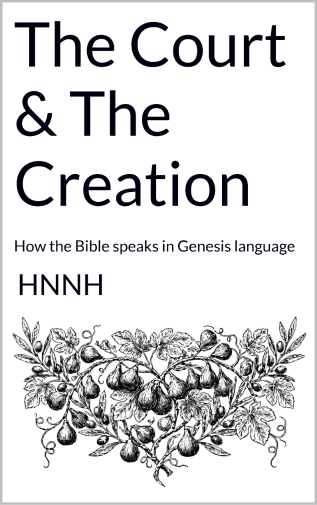
If you're wondering how these interpretations are being constructed, the first book explains the underlying structure and methodology.
Where to Begin
The foundational concepts are documented individually:
Following that, a series of passage-lesd articles offer a full demonstration of how the Genesis creation vocabulary operates across the whole of Scripture, from Genesis to Revelation.
Beyond those, the site runs to around 145 pages — the framework itself, plus passage-by-passage demonstrations of it applied to individual books, names, and characters.
About the Author
This site was built by HNNH. Follow this site's WhatsApp channel:hnnh.
Clicking on Bible verse references within articles opens a pop-up showing the passage, with a link to Blue Letter Bible where Hebrew name meanings can be found using the integrated Strong's Exhaustive Concordance. Blue Letter Bible also provides multiple translations and interlinear views.

