"By wisdom a house is built, and by understanding it is established; by knowledge the rooms are filled with all precious and pleasant riches." — Proverbs 24:3-4
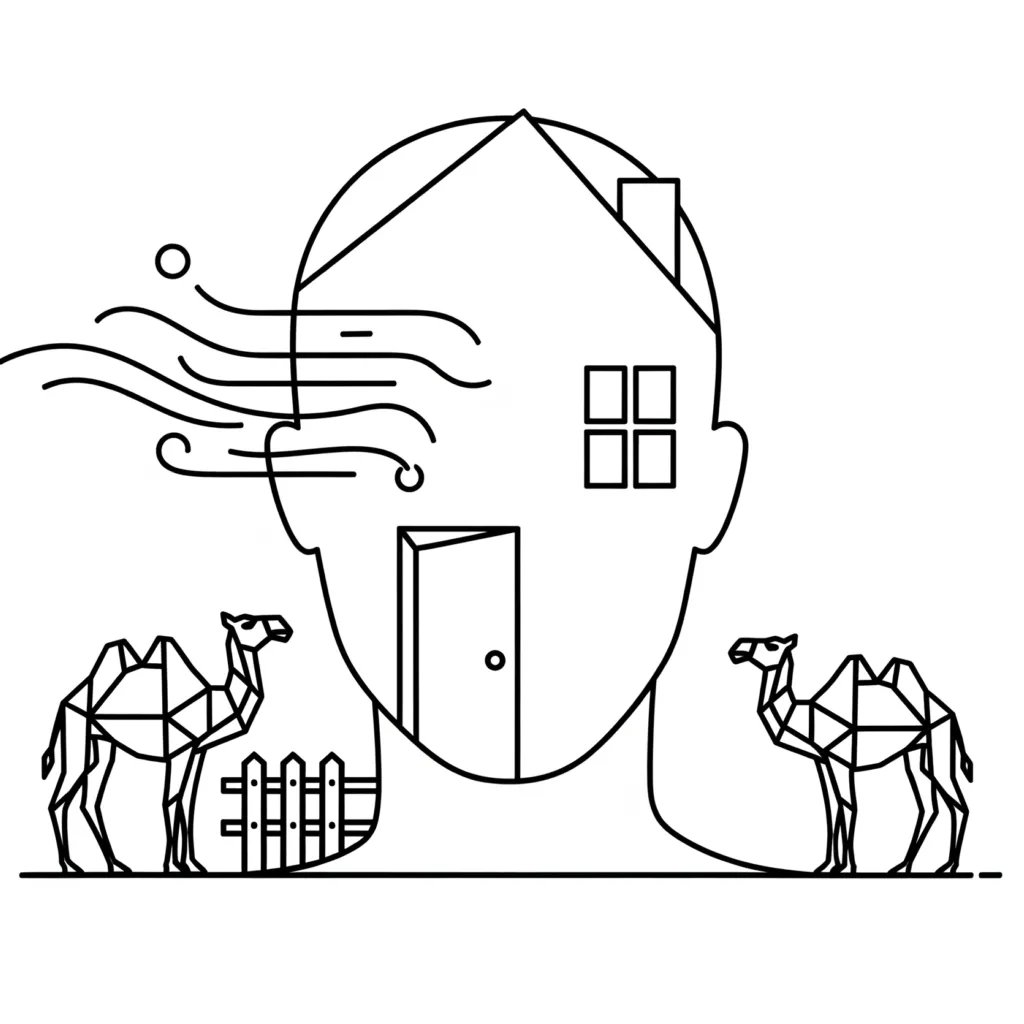
The Bible speaks consistently of houses, doors, and windows. These are not incidental details of ancient architecture. They form a sustained allegory running from Genesis to Revelation, disclosing the mechanics of consciousness, identity, and how new states of being are entered and sustained. The house is the self. The head is its highest chamber. The door is the threshold between one state of being and another. The window is the aperture through which vision and spirit enter. Breath is what animates the whole structure. And the vertical axis running through it all, from the lowest register of present circumstance to the highest chamber of assumed identity, is the axis of heaven and earth itself.
Heaven and Earth — The Two Registers
The first act of Elohim in the creation story is not the making of a single thing. It is the establishment of a vertical axis.
"At the first God made the heaven and the earth." — Genesis 1:1
Genesis 1 belongs entirely to Elohim, the Judges and Rulers of I AM, operating as the governing plurality that establishes the framework within which all identity will subsequently be assumed and enforced. Before light, before land, before any living thing, Elohim creates the two-register system. Heaven above. Earth below. This is not geography. It is the structural blueprint of consciousness itself, and everything built within the house of the self operates on this vertical axis.
Heaven is the upper register, the seat of the assumed I AM, the realm of imagination, vision, and uncrystallised potential. Earth is the lower register, present circumstance, the formed and manifest world that Elohim is currently enforcing into alignment with whatever the upper register declares. The relationship between them is the entire mechanic of the Linguistic Engine. What is occupied above is enforced below. What YHVH/LORD assumes as I AM in the upper register, Elohim must bring into correspondence in the lower.
"Let your kingdom come; let your will be done, as in heaven, so on earth." — Matthew 6:10
The Lord's Prayer is the clearest single statement of the mechanic in all of Scripture. The will established in the upper register, heaven, must be enforced into the lower register, earth. Elohim is the governing structure that administers this correspondence. The prayer is not a petition to an external authority. It is the precise operational statement of how identity assumed above becomes reality experienced below.
The second day of creation makes the structure explicit. Elohim places a firmament in the midst of the waters, dividing the waters above from the waters below. Waters throughout Scripture represent unformed states of consciousness, potential not yet crystallised into manifest circumstance. The waters above are the unformed imaginative potential of the upper register. The waters below are the circumstances already taking shape in the lower. The firmament, which Elohim names heaven, is the operative threshold between them, the boundary that both separates and connects the two registers. It functions within the house of the self exactly as the door and the window do, as the zone of passage and revelation between what is imagined and what is manifested.
"Heaven is my throne and the earth is my footstool." — Isaiah 66:1
The governing I AM is enthroned in the upper register. The lower register is where its authority rests and is enforced. Isaiah's declaration maps the same vertical axis onto the posture of sovereignty. The throne is above. The footstool is below. Elohim administers the distance between them, ensuring that the earth corresponds to the heaven that governs it.
The tabernacle and later the temple in Jerusalem were both built explicitly after the heavenly pattern. Exodus records that the earthly structure was to mirror precisely what was shown from above. The outer structure encodes the inner architecture. The heavenly pattern is the upper register. The earthly construction is the lower. The two must correspond because that correspondence is the law Elohim enforces. This is why the temple is never merely a building in Scripture. It is a statement about the relationship between the two registers of consciousness, and it is built inside the self before it is built in stone.
Genesis 2 introduces YHVH/LORD Elohim, present consciousness now actively inhabiting and interacting with the framework Elohim established in Genesis 1. The upper register is set. The lower is formed. Now YHVH/LORD enters the garden, assumes identity within it, and the relational mechanics of leaving and cleaving begin. Heaven provides the framework. Earth is where it is lived. The head, as the meeting point of both registers within the house of the self, is where the axis is planted.
The House as the Self
A house in Scripture is the dwelling place of life itself, the structure within which identity is formed, maintained, or collapsed. When YHVH/LORD, present consciousness, inhabits a house, the condition of that house mirrors the condition of the assumed I AM. Elohim, the internal governing structure, enforces whatever state the house is built upon.
David's story makes the pattern plain. He stood on the roof of his house, the uppermost point of his own awareness, and looked through the window at what seized his attention. The roof is the head, the highest chamber, the point where the upper and lower registers of the self meet. What followed was the full mechanics of assumed identity: perception, desire, occupation of a new state, and the consequences Elohim enforced according to it. The window is perception directed toward the upper register of imagination. The house is the self in which the drama unfolds.
"If a kingdom is divided against itself, that kingdom is not able to go on; and if a house is divided against itself, that house will not be able to go on." — Mark 3:24-25
A house divided is consciousness at war with itself, the internal judges of Elohim pulling in contradictory directions between the two registers, the upper declaring one identity while the lower enforces its opposite. The remedy is not external. It is the alignment of all inner governing voices beneath a single assumed I AM, so that heaven and earth within the self are brought into the correspondence the creation framework demands.
"If the Lord does not build the house, the work of the builders is to no purpose; if the Lord does not keep the town, the watchman keeps his watch for nothing." — Psalm 127:1
A house raised on the assumption of lack, limitation, or contradiction will be enforced accordingly. YHVH/LORD must be the builder, present consciousness assuming the correct I AM in the upper register, so that Elohim has the governing identity to enforce into the lower. The temple of Jerusalem and the tabernacle in the wilderness both mirror this: the outer structure reflects the inner architecture of identity that consciousness inhabits.
The Door — Dalet
The Hebrew letter dalet means door. Doors are not decorative features of the narrative. They are the operative thresholds between one state of consciousness and another, the passage through which YHVH/LORD moves when leaving a familiar identity and cleaving to a new one. The door is where the upper register and the lower meet at the level of action, the point of crossing from one assumed I AM into the next.
The name David, spelled Dalet-Vav-Dalet, places the beloved between two doors. He is framed as the passageway itself, the one through whose identity the movement from one state to another becomes possible. This connects directly to the leave-and-cleave structure: the old state is left, the door is crossed, and the new identity is assumed and sustained as marriage, the union of YHVH/LORD with the new I AM.
"Truly, I am the door of the sheep; all those who came before me are thieves and robbers, but the sheep did not give ear to them. I am the door; if any man goes in through me he will have salvation, and will go in and go out, and will have food." — John 10:7-9
The I AM declaration here is precisely the mechanism the creation framework describes. I AM the door is the identification of the assumed identity as the threshold itself, the passage between the lower register of present circumstance and the upper register of the fully realised state. YHVH/LORD assuming I AM as the door means that passage into the higher dwelling, the sustained state of provision and safety, comes through the act of occupying that identity. Elohim enforces the outcome.
"See, I am standing at the door, waiting; if any man gives ear to my voice and opens the door, I will come in to him, and will take food with him, and he with me." — Revelation 3:20
The door in Revelation 3:20 is the threshold of awareness between the two registers. The knock is the recognition of a desired state pressing at the boundary of present consciousness. Opening the door is the act of assuming the new I AM in the upper register rather than remaining locked in the familiar house of the old identity, allowing the correspondence between heaven and earth within the self to be re-established.
The Window — He
The Hebrew letter he carries the image of a window, and its meanings are breath, revelation, and the inflow of vision. Where the door governs crossing between states, the window governs what is seen from the upper register and what flows in from it. It is the aperture of imagination, the opening through which YHVH/LORD perceives a desired identity before it is fully assumed, and through which the animating breath of the upper register enters the lower.
"Make a window for the ark, and make it complete to the size of a cubit from the top." — Genesis 6:16
The ark is a house of salvation given a window at its highest point. What enters through that opening is light and orientation, the capacity to perceive the upper register beyond the flood of present circumstance surrounding the lower. Noah's window is the faculty of inner vision maintained above the waterline of manifest conditions, the link between the two registers held open when everything below is submerged.
"Put all your offerings into the store-house so that there may be food in my house, and put me to the test by doing so, says the Lord of armies, and see if I do not make the windows of heaven open and send down such a blessing on you that there is no room for it." — Malachi 3:10
The windows of heaven are the conditions under which the upper register flows into the lower. When the tithe, the full and first commitment to the assumed identity, is presented, the windows of the upper register open and Elohim enforces the downward correspondence. Heaven flows into earth. The upper register fills the lower. The mechanic is the same one established on the second day of creation when the firmament was set between the waters above and the waters below.
"The voice of my dear one! see, he comes, jumping over the mountains, springing over the hills. My dear one is like a roe or a young deer: see, he is standing by our wall, looking in at the windows, looking through the network." — Song of Songs 2:8-9
In the Song of Songs the beloved appears at the window, revealing himself through the lattice. This is the desired identity appearing to YHVH/LORD through the aperture of the upper register, seen in imagination before it is fully entered through the door. The window precedes the door. Vision in the upper register precedes assumption. Heaven is perceived before it is brought into correspondence with earth.
Rahab lowered the spies through her window in Jericho, and the scarlet cord she hung there became the mark of her deliverance. Paul escaped Damascus through a window let down in a basket, Eutychus fell asleep and fell from a window. In both cases the window is the opening through which transformation passes when the standard threshold is closed or guarded. The upper register always provides a way through when the lower appears to offer none.
The Head as House and Temple
The head is the uppermost chamber of the house of the self, and it is precisely at the head that the axis of heaven and earth is planted within the body. The head contains both registers: the upper chamber of imagination, vision, and assumed identity, and the lower faculty of present perception and circumstance. The temple built in Jerusalem, with its ascending chambers culminating in the Holy of Holies, encodes this vertical structure. The Holy of Holies is the highest register, the place where the governing I AM resides and where Elohim administers its enforcement downward through the whole structure.
"Then Jacob got up early in the morning, and took the stone which had been under his head, and put it up on end, and put oil on the top of it. And he gave that place the name of Beth-el." — Genesis 28:18-19
Jacob's dream at Bethel unites every element of the pattern. His head rests on the stone. The ladder opens between heaven and earth. YHVH/LORD speaks the I AM from the upper register. Angels ascend and descend, the correspondence between the two registers in constant motion. When Jacob wakes he names the place Beth-el, the house of God, and calls it the gate of heaven. The head is the house of God because it is where the ladder stands, where the vertical axis of heaven and earth is rooted within the self, and where vision opens between the two registers.
Jesus was crucified at Golgotha, the place of the skull. The symbolic address is precise. The skull is the seat of consciousness, the head as the meeting point of heaven and earth within the self. The cross planted at Golgotha is the vertical axis of the two registers fixed at the place of the head. Its upward reach is heaven. Its base is in the earth. The crucifixion at the place of the skull is the confrontation and removal of an old governing I AM and the establishment of a new one at the very point where the axis of heaven and earth meets the house of the self. The Goliath connection reinforces this. When David strikes Goliath and removes his head, the giant's dominance over the lower register ends. The severed head carried to Jerusalem and fixed, in the symbolic logic of the narrative, at the place of the skull, marks the transfer of sovereignty from one governing identity to another. Old I AM removed. New I AM established. Elohim enforces accordingly.
"His mischief returns upon his own head, and on his own skull his violence descends." — Psalm 7:16
What is assumed in the upper register of consciousness returns to its source as Elohim enforces it into the lower. The head, as the seat of the assumed I AM and the point where heaven meets earth within the self, receives the consequence of its own ruling. This is not punishment from outside. It is the mechanical operation of the two-register system. The upper register declares. The lower receives. The head is where the declaration originates and where its return is experienced.
"In the time when those who keep the house are shaking with fear, and the strong men are bent, and the women who were crushing grain have given up their work because their number is small, and those who are looking out of the windows are in the dark." — Ecclesiastes 12:3
Ecclesiastes 12 describes the decline of the body as a house falling into disrepair. The windows darkening are the eyes and the faculties of upper-register vision dimming. When the windows of the house go dark, the connection between the two registers weakens and Elohim enforces the correspondence between a diminished upper register and an increasingly constrained lower one.
Headship in Paul's letters carries the same structural meaning. Christ as head of the body and the governing identity as head of the household both describe the I AM assumed in the upper register in relation to the plurality it directs below. Elohim enforces what the head assumes. The head governs the house because the upper register of consciousness governs the lower, as heaven governs earth in the creation framework.
Breath and Spirit — Ruach and Pneuma
Breath is what makes the house alive. The Hebrew ruach and the Greek pneuma carry the same range of meaning: breath, wind, spirit. In the creation framework, the breath of Elohim moves upon the face of the waters at the very beginning, before the separation of heaven and earth, as the animating presence within the unformed potential. Breath belongs to the upper register. It enters the lower through the window of the house.
"And the Lord God made man from the dust of the earth, breathing into him the breath of life: and man became a living soul." — Genesis 2:7
The dust is the lower register fully formed but unanimated. The breath enters from above, from the upper register, through the window of the nostrils, and the lower register comes alive. Man becomes a living soul not through the forming but through the inflow from above. The two registers are united in a single living house by the breath that moves between them. This is YHVH/LORD Elohim operating in Genesis 2, present consciousness actively inhabiting the framework the creation mechanics of Genesis 1 established.
"And after he had said this, breathing on them, he said, Let the Holy Spirit come on them." — John 20:22
The breath given to the disciples after the resurrection is the assumption of a new governing I AM transmitted through the upper register into the lower. The house is filled by what breathes through it. The new identity, the risen state, is not argued or explained. It is breathed. The upper register opens and the lower receives.
The upper room at Pentecost is the highest chamber of the gathered body, the head of the assembled house. The Spirit descends as wind from above, entering through the highest window, consistent with the he imagery and with the windows of heaven in Malachi. Elohim enforces the new I AM across the plurality gathered beneath it, and the correspondence between the upper register of assumed identity and the lower register of lived experience is re-established in every one present.
The Complete Pattern
Drawn together, the symbols form a single coherent allegory that Scripture sustains from the first verse of Genesis to the last chapter of Revelation.
The vertical axis of heaven and earth is the foundational structure of consciousness, established by Elohim before any other creative act. The house of the self is built on this axis. The head is the chamber where the two registers meet, the temple at the summit of the house where the governing I AM is assumed and from which Elohim administers its enforcement downward through the whole structure. The door, dalet, is the threshold crossed when YHVH/LORD leaves a familiar state and cleaves to a new one, the operative moment of the Ask, Believe, Receive sequence at the boundary between the two registers. The window, he, is the aperture of imagination through which the desired identity in the upper register is first perceived and through which the animating breath of heaven enters the lower. Breath is the spirit that flows from the upper register through the window and makes the whole house alive.
The pattern appears in seed form at Bethel, where Jacob's head, the stone, the ladder between heaven and earth, and the naming of the house of God converge in a single night. It appears in the tabernacle built after the heavenly pattern, in the ascending chambers of the temple at Jerusalem, in the upper room at Pentecost, and at Golgotha where the vertical axis of heaven and earth is fixed at the place of the skull. It appears in every parable where a man builds a house on rock or sand, where a woman lights a candle and sweeps the lower register of her house searching for what was lost, or where a father watches from a distance for a son returning from the far country of a mislaid identity.
The prodigal son leaves the father's house, the place where the two registers are held in correspondence, and wastes his identity in a far country where the upper and lower registers have come apart. When he comes to himself, the language is precise. He re-enters his own upper register, recognises the house he has abandoned, and begins the return. The father sees him while he is still far off and runs. YHVH/LORD, present consciousness, moves toward the returning I AM before it has fully arrived. Elohim enforces the reunion because the identity of sonship was encoded in the name and in the upper register from the beginning. It was never revoked. Only vacated.
The new heaven and new earth of Revelation are not a future event external to the self. They are the renewal of both registers simultaneously, a complete identity replacement at every level of the house of consciousness. The old upper register and the old lower register pass away together. The new I AM is assumed in the upper. Elohim enforces the new earth in the lower. As in heaven, so on earth. The pattern that began in Genesis 1:1 completes itself in the same terms in which it opened.
"And do not let anyone put you out of your reward by a self-ruling spirit and the worshipping of angels, going into detail about the things which he has seen in a vision, being pulled up without cause by his unspiritual mind, and not keeping to the head, from whom all the body, being well joined together and united, gets growth through every living connection, the growth which is of God." — Colossians 2:18-19
The warning in Colossians is a warning about losing the head, the governing I AM in the upper register, in favour of fragmented voices operating independently in the lower. When the connection between the two registers is broken and the head is lost, the body cannot grow with the growth that is of God because Elohim has no coherent I AM to enforce. The house divides. The axis collapses. The windows of heaven close.
Reading Scripture this way reveals that every image of house, door, and window is an invitation to recognise yourself as the dwelling place in which heaven and earth meet, with the head as the temple where the axis is planted, the door as the threshold of your next assumed identity, and the window as the ever-open aperture through which the upper register pours its light and breath and vision into the lower to make the whole structure alive.
About The Author | Guides | Hebrew Alphabet Series | Breath Series | Architecture Series | Rock Series
